Showing posts with label Trump. Show all posts
Showing posts with label Trump. Show all posts
The Trump Medicine
As for Trump’s medicine? That is not only unlikely to deliver to the “ordinary” American he supposedly champions - it may well make their lives worse. At best his proposed income cuts look like benefiting the rich much more than the poor.
Brookings Institution research suggests that they would lead to the 0.1% of the population who earn over £3 million seeing their taxes fall on average by £88,000 (a cut of 14%). The poorest 20% of households, on the other hand, would see their taxes cut by only £88 (a cut of 0.8%).
Lily Batchelder of NYU and the Tax Policy Center are even more pessimistic.
According to their calculations, those who are just about managing will become in real terms worse off, whilst millionaires will get an average tax cut of £255,000, a single parent earning £60,000 with two school age children will face a tax increase of over £1,900.
Trump’s proposed corporation tax cuts - whilst candy for the stock market - won’t necessarily lead to more jobs and more investment.
History teaches us that such gains do not inevitably trickle down.
A similar tax reform in 2004 which encouraged US companies to bring their funds back into the US by cutting slashing taxes lead to no increase in investment and only a transitory increase in employment.
Companies instead increased their dividend payments and share buybacks.

Trump and Trade
IT MUST seem to Donald Trump that reversing globalisation is easy-peasy. With a couple of weeks still to go before he is even inaugurated, contrite firms are queuing up to invest in America. This week Ford cancelled a $1.6 billion new plant for small cars in Mexico and pledged to create 700 new jobs building electric and hybrid cars at Flat Rock in Michigan—while praising Mr Trump for improving the business climate in America. Other manufacturers, such as Carrier, have changed their plans, too. All it has taken is some harsh words, the odd tax handout and a few casual threats.
Mr Trump has consistently argued that globalisation gives America a poor deal. He reportedly wants to impose a tariff of 5% or more on all imports. To help him, he has assembled advisers with experience in the steel industry, which has a rich history of trade battles. Robert Lighthizer, his proposed trade negotiator, has spent much of his career as a lawyer protecting American steelmakers from foreign competition. Wilbur Ross, would-be commerce secretary, bought loss-making American steel mills just before George W. Bush increased tariffs on imported steel. Daniel DiMicco, an adviser, used to run Nucor, America’s biggest steel firm. Peter Navarro, an economist, author of books such as “Death by China” and now an adviser on trade, sees the decline of America’s steel industry as emblematic of how unfair competition from China has hurt America
What to expect from Trumponomics
While we don't have a clear picture yet of what the Trump Administration will propose to Congress on individual tax policy, we have some ideas. If you run a business or corporation, you'll find much to like. If you're a middle-income taxpayer, there are slim pickings.
Much of the Trump plan -- what he's made public to date -- follows the Republican template: Cut taxes for big business and high-income taxpayers and hope the tax savings will trickle down to create jobs and economic activity.
That premise has never proven to work in real life. After a raft of tax cuts from the George W. Bush years, economic activity is still well under 3% and shows no signs of perking up. Trump's allies have said they can return the GDP growth rate to the 4% level.
Trumponomics
A pack of Nobel Prize-winning economists gave Donald Trump and his policy plans the thumbs-down on Friday, with one saying the president-elect’s programs could lead to a deep recession.
Speaking on a panel during the first day of the annual American Economic Association meeting in Chicago, the Nobel laureates voiced a variety of concerns about the billionaire developer’s stance, from his haranguing of U.S. companies about their outsourcing plans to the risk that his tax and spending proposals could lead to run-away budget deficits.
“There is a broad consensus that the kind of policies that our president-elect has proposed are among the polices that will not work,” said Joseph Stiglitz, summing up the views of the panel that included his fellow Columbia University professor Edmund Phelps and Yale University’s Robert Shiller.
Trumponomics
Donald Trump’s administration will implement large tax cuts and substantial financial deregulation. President Trump may also change U.S. policies on trade, although precisely what he will do is less clear—and the shift may be more rhetorical than real. Trump is also likely to substantially cut or privatize federal spending. To the extent that his policies add up to a coherent economic strategy, they are reminiscent of Ronald Reagan’s, but with an extra dose of cronyism and the wild card of economic nationalism.
Trump himself and several of his key appointees are also poster children for oligarchy and even kleptocracy—government operated to serve the business interests of elites, including top officials. The intermingling of business, family, and government as the Trump administration takes shape unfortunately parallels what I have observed in corrupt developing countries over the past 30 years, including during my time as chief economist for the International Monetary Fund.
Trump presidency is a threat to the global economy....
Donald Trump’s presidency poses a risk to the global economy, a leading credit ratings agency has warned, highlighting his unpredictability, his administration’s aggressive tone and his break with established “norms” in international relations.
Less than a month into a presidency characterised by frequent Twitter tirades and an executive to order to ban citizens from some Muslim-majority countries from entering the US, Fitch said Trump posed a threat to global economic conditions.
Fitch is one of three big ratings agencies that assign credit scores to governments based on their perceived ability to repay debts. It said in Friday’s strongly worded statement that the new US administration could damage those scores, known as sovereign ratings.
Trump and Tariffs
“If you want to build cars in the world, then I wish you all the best. You can build cars for the United States, but for every car that comes to the USA, you will pay 35 per cent tax,” Trump said in remarks translated into German.
Read more: Auto sector nervously awaits the Trump card
“I would tell BMW that if you are building a factory in Mexico and plan to sell cars to the USA, without a 35 per cent tax, then you can forget that,” Trump said.
At 1155 GMT, BMW shares were down 2.2 per cent, while Volkswagen’s (VW) and Daimler’s were both down 2 per cent.
Under pressure to deliver on campaign promises to revive U.S. industrial jobs, Trump has turned his fire on carmakers that use low-cost Mexican plants to serve the U.S. market. He has also warned Japan’s Toyota it could be subject to a “big border tax” if it builds its Corolla cars for the U.S. market at a planned factory in Mexico.
TTIP
What is the Transatlantic Trade and Investment Partnership (TTIP)?
This is a deal being negotiated between the European Union and the United States.Deliberations over the deal have been going on for years, but the first official round of talks took place in 2013.
It is hoped that whatever the agreement eventually looks like, it will result in increased trade and prosperity for those on both sides of the Atlantic.
Lower barriers to trade should
mean that more of it takes place, and the ensuing competition should
result in better and cheaper goods and services, making all sides better
off.
But it's not just tariffs that the TTIP is meant to tackle. Politicians also want to get rid of non-tariff barriers, known as NTBs, which are rules that countries or regions, such as the EU, impose on goods, such as standards and sizes.
TTIP is intended to bring about lower trade tariffs, and to reduce regulatory barriers that make trade between the US and the EU more costly than it need be. If approved by US and EU politicians, TTIP would be the biggest agreement of its kind.
But it's not just tariffs that the TTIP is meant to tackle. Politicians also want to get rid of non-tariff barriers, known as NTBs, which are rules that countries or regions, such as the EU, impose on goods, such as standards and sizes.
TTIP is intended to bring about lower trade tariffs, and to reduce regulatory barriers that make trade between the US and the EU more costly than it need be. If approved by US and EU politicians, TTIP would be the biggest agreement of its kind.
But the UK's decision to vote for
Brexit, and the election of Trump, make TTIP's future decidedly
uncertain, with many commentators now assuming that the agreement is
dead in the water.
By extension, he is also deeply critical of TTIP and is widely expected to either ditch the deal or renegotiate the trade deal.
Trump does not like the deals because he thinks they will hurt American workers and undercut US companies. His stance on trade is protectionist: he has vowed to shield Americans from the effects of globalised trade by slapping hefty tariffs on cheap Chinese imports of up to 45pc.
He has even talked of getting ride of Nafta, the North American Free Trade Area, and questioned the US' relationship with the World Trade Organisation.
He fears previously protected sectors in the US could be subject to liberalised rules that will disadvantage them. Many American states have “buy American” policies, and would put up a fight at the idea of TTIP overruling these.
Trump also wants to appoint "tough and smart trade negotiators to fight on behalf of American workers".
Read more....
The Biggest Threat to UK Democracy?
WHAT IS THE TTIP?
The Transatlantic Trade and Investment Partnership (TTIP) is a comprehensive free trade and investment treaty currently being negotiated – in secret – between the European Union and the USA. As officials from both sides acknowledge, the main goal of TTIP is to remove regulatory ‘barriers’ which restrict the potential profits to be made by transnational corporations on both sides of the Atlantic. (Pay particular attention to the 'in secret' element. You are not supposed to know too much about this Partnership, even though it might have a big effect on the future of our country.)
Since the EU has much stronger trade regulations protecting public health, food safety, and the environment, this 'harmonisation' really means deregulation in the EU; reducing protections for the environment and public health, in favour of exploiting them for corporate profits.
The deal is being celebrated all around by the Tories, Labour, Liberal Democrats and UKIP for its potential job creation and gains. However, the trade deal has MANY potentially serious issues that our Politicians are reluctant to talk about.
WHY SHOULD I BE WORRIED ABOUT TTIP?
The regulatory ‘barriers’ are in reality some of our most prized social standards and environmental regulations, such as labour rights, food safety rules (including restrictions on GMOs), regulations on the use of toxic chemicals, digital privacy laws and even new banking safeguards introduced to prevent a repeat of the 2008 financial crisis. The stakes, in other words, could not be higher.
Thanks to the proposed deal's "Investor State Dispute Settlement", companies will be able to sue governments whose regulations put future profits at risk. So for example, fracking firms could take the government to court banning risky drilling, or private healthcare providers could sue a government which tries to protect the NHS. Or, perhaps an American tobacco company could chose to sue the UK if the Government tried to introduce controls on the sale of cigarettes, or wanted to introduce stricter control on advertising tobacco products. There are many possible scenarios where the commercial interests of a company, including overseas companies, could override our own national interests.
Further to the above, in order to trade under the TTIP, the UK could be forced to accept rules from other countries - which doesn't bode well for people complaining about the UK having too many laws from Brussels. Unions are also concerned that the weakened regulations will allow bosses to reduce wages and labour rights will suffer.
Our food regulations could also be worn down. Thanks to the equalisation of rules between the US and EU as part of the deal, the UK could be forced to relax regulations which could see the return of banned food products in Europe like chicken bleached with chlorine and growth hormones in beef.
Our environmental standards could be undermined. In order to match US standards, UK could be forced to reverse its ban on asbestos - which has been linked to lung cancer and mesothelioma.
Your data and privacy could be at risk. US citizens do not have the same level of protection for their private data as EU citizens, so e-commerce provisions under the deal could see the safety of your private data put at risk.
As if all this was not enough, we are in the dark about much of the deal. Parts of the deal will only be unveiled once they're finally agreed by European Commission and US officials. Green Party MEP Keith Taylor told a reporter: "Even my colleagues who sit on the European Parliament's Trade Committee don't get a proper look at the negotiating document, and most MEPs don't get any say on the deal until we're presented it as a fait accompli.
Source: http://mikelclayton.blogspot.co.uk/2014/08/the-dummies-guide-to-ttip-part-one.html
Why doesn't Trump like these deals?
Although Trump’s policy statements have been, at best, contradictory, he has been consistent in his opposition to TPP. "There is no way to fix the TTP," the president-elect said in June.By extension, he is also deeply critical of TTIP and is widely expected to either ditch the deal or renegotiate the trade deal.
Trump does not like the deals because he thinks they will hurt American workers and undercut US companies. His stance on trade is protectionist: he has vowed to shield Americans from the effects of globalised trade by slapping hefty tariffs on cheap Chinese imports of up to 45pc.
He has even talked of getting ride of Nafta, the North American Free Trade Area, and questioned the US' relationship with the World Trade Organisation.
He fears previously protected sectors in the US could be subject to liberalised rules that will disadvantage them. Many American states have “buy American” policies, and would put up a fight at the idea of TTIP overruling these.
Trump also wants to appoint "tough and smart trade negotiators to fight on behalf of American workers".
Read more....
The Biggest Threat to UK Democracy?
WHAT IS THE TTIP?
The Transatlantic Trade and Investment Partnership (TTIP) is a comprehensive free trade and investment treaty currently being negotiated – in secret – between the European Union and the USA. As officials from both sides acknowledge, the main goal of TTIP is to remove regulatory ‘barriers’ which restrict the potential profits to be made by transnational corporations on both sides of the Atlantic. (Pay particular attention to the 'in secret' element. You are not supposed to know too much about this Partnership, even though it might have a big effect on the future of our country.)
Since the EU has much stronger trade regulations protecting public health, food safety, and the environment, this 'harmonisation' really means deregulation in the EU; reducing protections for the environment and public health, in favour of exploiting them for corporate profits.
The deal is being celebrated all around by the Tories, Labour, Liberal Democrats and UKIP for its potential job creation and gains. However, the trade deal has MANY potentially serious issues that our Politicians are reluctant to talk about.
WHY SHOULD I BE WORRIED ABOUT TTIP?
The regulatory ‘barriers’ are in reality some of our most prized social standards and environmental regulations, such as labour rights, food safety rules (including restrictions on GMOs), regulations on the use of toxic chemicals, digital privacy laws and even new banking safeguards introduced to prevent a repeat of the 2008 financial crisis. The stakes, in other words, could not be higher.
Thanks to the proposed deal's "Investor State Dispute Settlement", companies will be able to sue governments whose regulations put future profits at risk. So for example, fracking firms could take the government to court banning risky drilling, or private healthcare providers could sue a government which tries to protect the NHS. Or, perhaps an American tobacco company could chose to sue the UK if the Government tried to introduce controls on the sale of cigarettes, or wanted to introduce stricter control on advertising tobacco products. There are many possible scenarios where the commercial interests of a company, including overseas companies, could override our own national interests.
Further to the above, in order to trade under the TTIP, the UK could be forced to accept rules from other countries - which doesn't bode well for people complaining about the UK having too many laws from Brussels. Unions are also concerned that the weakened regulations will allow bosses to reduce wages and labour rights will suffer.
Our food regulations could also be worn down. Thanks to the equalisation of rules between the US and EU as part of the deal, the UK could be forced to relax regulations which could see the return of banned food products in Europe like chicken bleached with chlorine and growth hormones in beef.
Our environmental standards could be undermined. In order to match US standards, UK could be forced to reverse its ban on asbestos - which has been linked to lung cancer and mesothelioma.
Your data and privacy could be at risk. US citizens do not have the same level of protection for their private data as EU citizens, so e-commerce provisions under the deal could see the safety of your private data put at risk.
As if all this was not enough, we are in the dark about much of the deal. Parts of the deal will only be unveiled once they're finally agreed by European Commission and US officials. Green Party MEP Keith Taylor told a reporter: "Even my colleagues who sit on the European Parliament's Trade Committee don't get a proper look at the negotiating document, and most MEPs don't get any say on the deal until we're presented it as a fait accompli.
Source: http://mikelclayton.blogspot.co.uk/2014/08/the-dummies-guide-to-ttip-part-one.html
Trump's Economic Plans
Donald Trump says he will not delay
"making America great again" - and the new US president has already
begun unpicking some of his predecessor's policies, including Barack
Obama's signature healthcare system.
So some quickfire changes to economic policy could well be in the pipeline.On the campaign trail, the rhetoric was passionate. So, now that Mr Trump is in the Oval Office, what are we likely to see?
Deregulation
Barely had the inauguration ended than White House Chief of Staff Reince Priebus called a halt to the introduction of any new regulations. That sounds like a bold move to cut red tape and, during the election, Mr Trump did promise to cut back the regulatory burden on business.But a stay on new laws is actually quite common for an incoming president.
The most controversial part of President Trump's move was to freeze regulations concerning President Obama's Affordable Care Act, nicknamed Obamacare. It's still not clear what this will mean for individuals who have taken out insurance or the private insurers covering them. But the new president has vowed to "repeal and replace" the scheme.
As for the other legislation that's been put on hold, it will now be "reviewed". But there's likely to be more to it than that. Trump cabinet member Wilbur Ross suggested last year that cutting regulation would save business $200bn (£161bn) annually. He singled out restrictions on health and safety and the coal industry as ripe for repeal.
Trade
If President Trump has made one thing clear it's that he believes current international trade arrangements "put the interests of insiders and the Washington elite over the hard-working men and women of this country" as the White House website now states.Read more...
Trump and Trade
President Donald Trump has fulfilled
a campaign pledge by signing an executive order to withdraw from the
Trans-Pacific Partnership (TPP).
"Great thing for the American worker what we just did," said Mr Trump as he dumped the pact with a stroke of a pen.
He also cut funding for international groups that provide abortions, and froze hiring of some federal workers.
Mr Trump's executive order on TPP was largely symbolic since the deal has not been ratified by a divided US Congress.
During his presidential campaign, he criticised the accord as a "potential disaster for our country", arguing it harmed US manufacturing.
What is the TPP?
- The trade deal, which covered 40% of the world's economy, was negotiated in 2015 by nations including the US, Japan, Malaysia, Australia, New Zealand, Canada and Mexico
- TPP's stated aim was to strengthen economic ties and boost growth, including by reducing tariffs
- It included measures to enforce labour and environmental standards, copyrights, patents and other legal protections
- The agreement, backed heavily by US business, was designed to potentially create a new single market likened to the EU
- Critics argued it was a not-so-secret gambit to box in China, which is not part of the agreement
TPP in a nutshell
Twelve countries that border the Pacific Ocean signed up to the TPP in February 2016, representing roughly 40% of the world's economic output.The pact aimed to deepen economic ties between these nations, slashing tariffs and fostering trade to boost growth. Members had also hoped to foster a closer relationship on economic policies and regulation.
The agreement was designed so that it could eventually create a new single market, something like that of the EU.
But all 12 nations needed to ratify it, before it could come into effect.
Once Donald Trump won last year's election, the writing was on the wall for the TPP.
US participation was the major linchpin for the deal. It may be possible for the other countries to forge a smaller scale pact in it's place, but it can't go ahead in its current form.
Those other member states are: Japan - the only country to have already ratified the pact - Malaysia, Vietnam, Singapore, Brunei, Australia, New Zealand, Canada, Mexico, Chile and Peru.
For and against
Former President Barack Obama treated trade deals as a priority during his tenure, and this particular deal would have bolstered America's position in the Asia-Pacific region, where China is growing in influence.But US opponents have characterised the TPP as a secretive deal that favoured big business and other countries at the expense of American jobs and national sovereignty.
On the campaign trail Donald Trump called it a "horrible deal".
Read more...
The Chinese government will rejoice
to hear Donald Trump promise that the US will quit the Trans-Pacific
Partnership (TPP) on his first day in the White House.
For years,
Beijing has listened to the Obama administration say the 12-nation
regional trade deal was a way of bolstering American leadership in Asia. China was not included in the deal, and President Barack Obama went out of his way to remind the region that this was no accident. TPP allows America - and not countries like China - to write the rules of the road in the 21st Century, which is especially important in a region as dynamic as the Asia-Pacific.
Nor was this ever just about the rules on trade. TPP was a core part of the Obama administration's strategic "pivot to Asia". US Defence Secretary Ash Carter said that alongside boosting US exports, it would strengthen Washington's key relationships in the Asia-Pacific, signal US commitment to the region and promote American values.
"Passing TPP is as important to me as another aircraft carrier," he insisted.
Read more...
Trump's Protectionism

Protectionism represents any attempt to impose restrictions on trade in goods and services
Trade disputes between countries happen because one or
more parties either believes that trade is being conducted unfairly, on
an uneven playing field, or because they believe that there is one or
more economic or strategic justifications for import controls.
All countries operate with some forms of import controls
The aim is to cushion domestic businesses and industries from overseas competition and prevent the outcome resulting from the inter-play of free market forces of supply and demand.
Different forms of protectionism
All countries operate with some forms of import controls
The aim is to cushion domestic businesses and industries from overseas competition and prevent the outcome resulting from the inter-play of free market forces of supply and demand.
Different forms of protectionism
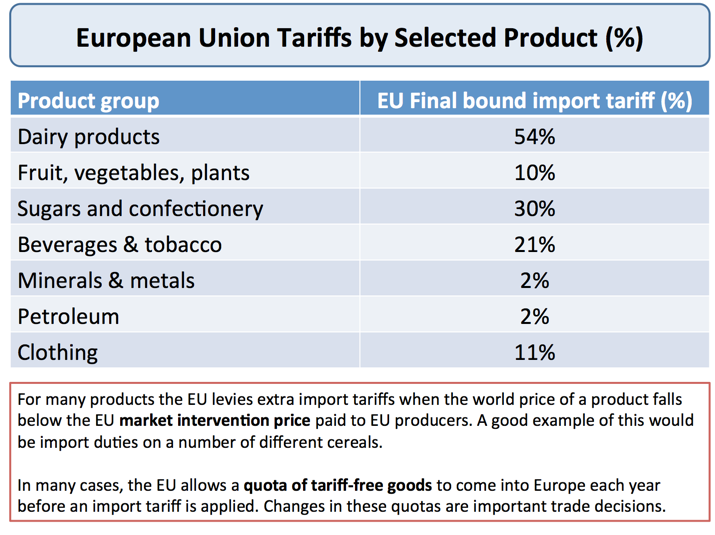
- Tariffs - a tax or duty that raises the price of imported products and causes a contraction in domestic demand and an expansion in domestic supply. For example, until recently, Mexico imposed a 150% tariff on Brazilian chicken. The United States has an 11% import tariff on imports of bicycles from the UK.
- Quotas – these are quantitative (volume) limits on the level of imports allowed or a limit to the value of imports permitted into a country in a given time period. Until 2014, South Korea maintained strict quotas on imported rice. It has now replaced an annual import quota with import tariffs designed to protect South Korean rice farmers. Quotas do not normally bring in any tax revenue for the government
- Voluntary Export Restraint – this is where two countries make an agreement to limit the volume of their exports to one another over an agreed time period. Sometimes this is enforced by a government for example the USA enforced VER on Japan during the late 1980s
- Intellectual property laws e.g. patents and copyright protection
- Technical barriers to trade including product labeling rules and stringent sanitary standards. These increase product compliance costs and impose monitoring costs on export agencies. Huge vertically integrated businesses can cope with these non-tariff barriers but many of the least developed countries do not have the some technical sophistication to overcome these barriers.
- Preferential state procurement policies – this is where a government favour local/domestic producers when finalizing contracts for state spending e.g. infrastructure projects or purchasing new defence equipment
- Export subsidies - a payment to encourage domestic production by lowering their costs. Soft loans can be used to fund the dumping of products in overseas markets. Well known subsidies include Common Agricultural Policy in the EU, or cotton subsidies for US farmers and farm subsidies introduced by countries such as Russia. In 2012, the USA government imposed tariffs of up to 4.7 per cent on Chinese manufacturers of solar panel cells, judging that they benefited from unfair export subsidies after a review that split the US solar industry.
- Domestic subsidies – government help (state aid) for domestic businesses facing financial problems e.g. subsidies for car manufacturers or loss-making airlines.
- Import licensing - governments grants importers the license to import goods.
- Exchange controls - limiting the foreign exchange that can move between countries – this is also known as capital controls
- Financial protectionism – for example when a national government instructs banks to give priority when making loans to domestic businesses
- Murky or hidden protectionism - e.g. state measures that indirectly discriminate against foreign workers, investors and traders. A government subsidy that is paid only when consumers buy locally produced goods and services would count as an example. Deliberate intervention in currency markets might also come under this category.
Examiner’s tip: the tariff is frequently examined. Ensure that you can analyse the removal as well as the imposition of a tariff.

Economics Consequences of Trump's win
For those of us who were wrong
about the US presidential election, it is worth suppressing emotional
reactions, at least for a month or two, and attempting a dispassionate
judgment about what Donald Trump’s administration may mean for the
world. So here are 10 likely consequences of the Trump presidency,
divided equally between the good and the bad.
The good news starts with US growth, which will almost surely accelerate above the 2.2% average annual rate during Barack Obama’s second term. This is because the Republican aversion to public spending and debt applies only when a Democrat like Obama occupies the White House. With a Republican president, the party has always been glad to boost public spending and relax debt limits, as it was under Presidents Ronald Reagan and George W Bush. Thus, Trump will be able to implement the Keynesian fiscal stimulus that Obama often proposed but was unable to deliver.
The resulting deficits may be described as “supply-side economics”, rather than Keynesian stimulus, but the effect will be the same: growth and inflation will both increase. As the US economy runs into the limits of full employment, additional growth will push inflation higher, but that bad news can wait until 2018 and beyond.
Second, sensible tax reforms, such as an amnesty for multinational companies that repatriate foreign profits, will finally become law. The Republicans’ hegemony will enable easy agreement on tax cuts financed mainly by higher public borrowing, rather than by facing down special interest lobbies’ resistance to the elimination of exemptions and loopholes. These tax reforms will create even bigger budget deficits, which in turn will stimulate more growth and inflation.
A third boost to economic growth will come from deregulation. While battles over energy and environmental laws may dominate the headlines, the biggest economic impact will come from reversing bank regulations. As banks are encouraged to loosen lending standards, especially for middle-income households, an upswing in residential construction and debt-financed consumption should add further growth impetus. Excessive deregulation could cause a re-run of the 2007 financial crisis, but that, too, is a risk for 2018 and beyond.
Fourth, Trump could be good for geopolitical stability, at least in the short term. Trump’s preference for transactional realpolitik over Obama’s liberal interventionism should stabilise relations with Russia and China as the world is divided into spheres of influence. Trump could give Russia freer rein in Ukraine and Syria in exchange for restraint in central Europe and the Baltics. China’s inevitable dominance in Asia could be accepted, provided it avoids outright wars with Japan, Taiwan, and other countries whose security is, in theory, guaranteed by treaties with the US. The Middle East is bound to remain a cauldron of geopolitical unrest; but, even here, Trump’s preference for local strongmen over “democracy promotion” could restore a degree of stability (at the cost of human rights).
Finally, Trump’s election could force Americans to recognise flaws in their own democracy, even as they abandon global “democracy promotion.” The fact that Trump lost the popular vote by more than 2 million could re-energise efforts to reform the electoral college – efforts that already have resulted in the necessary legislation in states representing 61% of the required votes. And the overwhelming opposition to Trump in trend-setting states such as California and New York could encourage their voters to elect legislatures to counteract federal conservatism with progressive state laws on issues ranging from air quality and health care to abortion, treatment of immigrants, and gun control.
Now for the bad news. For the first time since the 1930s, the US has a president who views trade as a zero-sum game. Trump’s protectionist campaign rhetoric may not have been meant literally, but if he fails to deliver any of the trade curbs that he promised, Republicans will suffer a backlash from what is now their core voter constituency, voters in declining industries and regions.
US global leadership is therefore bound to shift away from free trade, globalisation, and open markets. Nobody can predict the full effects of the biggest regime change in global economic management since the 1980s; but they will surely be negative for emerging economies and multinational companies, whose development models and business strategies have assumed free trade and open capital flows.
A second, more immediate, threat stems from enacting large tax cuts and boosting public spending in an economy already nearing full employment, which implies accelerating inflation, higher interest rates, or probably some combination of the two. Given the likelihood of additional trade protectionism and measures to remove immigrant workers, the increase in inflation and long-term interest rates could be quite dramatic. The impact on financial markets will be disruptive, regardless of whether the Fed aggressively tightens monetary policy to pre-empt rising prices or lets the economy “run hot” for a year or two, allowing inflation to accelerate.
With the US economy growing faster than expected and long-term interest rates rising, excessive strengthening of the dollar is a third major risk. Even though the dollar is already overvalued, it could move into a self-reinforcing upward spiral, as it did in the early 1980s and late 1990s, owing to dollar debts accumulated in emerging markets by governments and companies tempted by near-zero interest rates.
Fourth, the combination of a dollar squeeze and protectionism spells big trouble for developing countries, with the possible exception of some relatively closed economies such as Brazil, Russia, and India, whose development strategies are less reliant on free trade and foreign financing.
Finally, the most dangerous consequence of Trump’s victory may be its contagion effect on Europe. Just as Britain’s referendum proved uncannily predictive of Trump’s win, Trump looks like a leading indicator of populist upheavals in Europe, which could trigger another euro crisis and threaten the breakup of the European Union. The next anti-establishment victories, according to opinion polls, will be in Italy’s constitutional referendum and Austria’s presidential election. Globalists can only hope that the polls again turn out to be wrong – but in the opposite direction.
Source: The Guardian
The good news starts with US growth, which will almost surely accelerate above the 2.2% average annual rate during Barack Obama’s second term. This is because the Republican aversion to public spending and debt applies only when a Democrat like Obama occupies the White House. With a Republican president, the party has always been glad to boost public spending and relax debt limits, as it was under Presidents Ronald Reagan and George W Bush. Thus, Trump will be able to implement the Keynesian fiscal stimulus that Obama often proposed but was unable to deliver.
The resulting deficits may be described as “supply-side economics”, rather than Keynesian stimulus, but the effect will be the same: growth and inflation will both increase. As the US economy runs into the limits of full employment, additional growth will push inflation higher, but that bad news can wait until 2018 and beyond.
Second, sensible tax reforms, such as an amnesty for multinational companies that repatriate foreign profits, will finally become law. The Republicans’ hegemony will enable easy agreement on tax cuts financed mainly by higher public borrowing, rather than by facing down special interest lobbies’ resistance to the elimination of exemptions and loopholes. These tax reforms will create even bigger budget deficits, which in turn will stimulate more growth and inflation.
A third boost to economic growth will come from deregulation. While battles over energy and environmental laws may dominate the headlines, the biggest economic impact will come from reversing bank regulations. As banks are encouraged to loosen lending standards, especially for middle-income households, an upswing in residential construction and debt-financed consumption should add further growth impetus. Excessive deregulation could cause a re-run of the 2007 financial crisis, but that, too, is a risk for 2018 and beyond.
Fourth, Trump could be good for geopolitical stability, at least in the short term. Trump’s preference for transactional realpolitik over Obama’s liberal interventionism should stabilise relations with Russia and China as the world is divided into spheres of influence. Trump could give Russia freer rein in Ukraine and Syria in exchange for restraint in central Europe and the Baltics. China’s inevitable dominance in Asia could be accepted, provided it avoids outright wars with Japan, Taiwan, and other countries whose security is, in theory, guaranteed by treaties with the US. The Middle East is bound to remain a cauldron of geopolitical unrest; but, even here, Trump’s preference for local strongmen over “democracy promotion” could restore a degree of stability (at the cost of human rights).
Finally, Trump’s election could force Americans to recognise flaws in their own democracy, even as they abandon global “democracy promotion.” The fact that Trump lost the popular vote by more than 2 million could re-energise efforts to reform the electoral college – efforts that already have resulted in the necessary legislation in states representing 61% of the required votes. And the overwhelming opposition to Trump in trend-setting states such as California and New York could encourage their voters to elect legislatures to counteract federal conservatism with progressive state laws on issues ranging from air quality and health care to abortion, treatment of immigrants, and gun control.
Now for the bad news. For the first time since the 1930s, the US has a president who views trade as a zero-sum game. Trump’s protectionist campaign rhetoric may not have been meant literally, but if he fails to deliver any of the trade curbs that he promised, Republicans will suffer a backlash from what is now their core voter constituency, voters in declining industries and regions.
US global leadership is therefore bound to shift away from free trade, globalisation, and open markets. Nobody can predict the full effects of the biggest regime change in global economic management since the 1980s; but they will surely be negative for emerging economies and multinational companies, whose development models and business strategies have assumed free trade and open capital flows.
A second, more immediate, threat stems from enacting large tax cuts and boosting public spending in an economy already nearing full employment, which implies accelerating inflation, higher interest rates, or probably some combination of the two. Given the likelihood of additional trade protectionism and measures to remove immigrant workers, the increase in inflation and long-term interest rates could be quite dramatic. The impact on financial markets will be disruptive, regardless of whether the Fed aggressively tightens monetary policy to pre-empt rising prices or lets the economy “run hot” for a year or two, allowing inflation to accelerate.
With the US economy growing faster than expected and long-term interest rates rising, excessive strengthening of the dollar is a third major risk. Even though the dollar is already overvalued, it could move into a self-reinforcing upward spiral, as it did in the early 1980s and late 1990s, owing to dollar debts accumulated in emerging markets by governments and companies tempted by near-zero interest rates.
Fourth, the combination of a dollar squeeze and protectionism spells big trouble for developing countries, with the possible exception of some relatively closed economies such as Brazil, Russia, and India, whose development strategies are less reliant on free trade and foreign financing.
Finally, the most dangerous consequence of Trump’s victory may be its contagion effect on Europe. Just as Britain’s referendum proved uncannily predictive of Trump’s win, Trump looks like a leading indicator of populist upheavals in Europe, which could trigger another euro crisis and threaten the breakup of the European Union. The next anti-establishment victories, according to opinion polls, will be in Italy’s constitutional referendum and Austria’s presidential election. Globalists can only hope that the polls again turn out to be wrong – but in the opposite direction.
Source: The Guardian
Trump's Economic Plan
First 100 Days
On November 22, Trump promised to make the following Executive Orders. First, withdraw from the Trans-Pacific Partnership. He will replace it with a series of bilateral agreements that protect American jobs.That means eleven new agreements with the other signatories.
Second,
cancel restrictions on shale oil, clean coal, and other energy
production. Third, any federal agency that proposes a new regulation
must identify two existing ones that will be eliminated.Fourth, ask the Defense Department to develop a plan to protect the nation's infrastructure from cyber-attacks. Fifth, ask the Labor Department to identify any abuse of the nation's visa program.
Sixth, propose a five-year ban on executive officials becoming lobbyists. (This was also proposed by Obama during his 2008 campaign.) There will be a lifetime ban for any executive lobbying on behalf of another country.
Trump has the support of the Republican-controlled Congress. That makes it more likely his other measures will get passed. Here is Trump's economic plan, and how it will impact you.
"5-Part Tax Plan"
Eliminate the marriage penalty, the Alternative Minimum Tax, and the inheritance tax. Quadruple the standard deduction. Trump also added a childcare deduction.
It would allow parents to deduct
the average cost of childcare expenses. (Source: "An America First
Economic Plan," Donald J. Trump. "Donald Trump Just Made Major Changes
to His Tax Plan," CNBC, August 8, 2016.)
| Current Income Tax Rate | Trump's Tax Plan | Income Levels for Those Filing As: | |||
|---|---|---|---|---|---|
| Income | Cap Gains | Single | Married-Joint | ||
| 10%-15% | 12% | 0% | $0-$37,500 | $0 - $75,000 | |
| 25%-28% | 25% | 15% | $37,500 - $112,500 | $75,000 - $225,000 | |
| 28%-39.6% | 33% | 20% | $112,500 + | $225,000 + | |
Lower the maximum small business and corporate tax rate from 38 percent to 15 percent. Get corporations to bring money back into the United States. Keep companies in this country. The United States is the highest taxed nation in the world. He would get the right people into the room, and get all to agree how to do it.
The effective tax rate is only 15 percent. That's because most corporations have figured out how to avoid it. Nearly half pay no taxes at all since they pass those taxes to their shareholders. A lower corporate tax rate would increase profits without necessarily creating new jobs. That's because supply-side economics doesn't work at today's relatively low tax rates. (Source: "Donald Trump Tax Reform," OnTheIssues.org.)
The taxes for the rich would go up somewhat. If I increase it on the wealthy, they're still going to pay less than they pay now. Trump has given conflicting statements on how his tax plan will affect high-income taxpayers (the top 20 percent).
They would receive a 9.5
percent decrease in the tax rate. (Source: "Donald Trump Tries to Clean
Up Economic Comments," CNN, May 10, 2016.)
End tax deferral on the $5 trillion in corporate cash held abroad. Allow a one-time repatriation that will be taxed 10 percent. Eliminate loopholes available to the very rich and corporations, such as the exemption on life insurance interest. Steepen the curve of the Personal Exemption Phaseout and the Pease Limitation on itemized deductions. Phase in a cap on business interest expenses. (Source: CNBC Interview, March 10, 2016. "Tax Reform," DonaldJTrump.com.)
Eliminate the "carried interest" deduction. It allows managers of hedge funds and private equity funds to be taxed at the capital gains tax rate (15 percent) instead of the income tax rate (39.6 percent). (Source: "Hedge Fund Managers Are Getting Away With Murder," Fortune, August 24, 2015.)
To find out how this plan will affect you, see Trump's Tax Plan.
"Cut Government Spending"
Make the U.S. military so strong no one will mess with us. Get more equipment. Bomb ISIS and send troops to Syria. Cancel Iran nuclear deal. Use Russia as an ally in Syria. Use waterboarding. Use military force against terrorists' families. Opposed Iraq war. In a November 22 interview with the New York Times, Trump said he no longer supports waterboarding. He based his change of heart on a conversation with retired Marine Corps General James Mattis. He also said he might appoint his son-in-law, Jared Kushner, as a special envoy to broker peace between the Israelis and Palestinians. (Source: "Donald Trump on War & Peace," "Donald Trump on Homeland Security," OntheIssues.org. "Donald Trump and the Defense Budget," National Interest.org, December 30, 2015.)Cut defense spending, but 3 percent of GNP for military spending is too low, it should be 6.5 percent. U.S. military spending is almost $800 billion a year. It's larger than anything other government expenditure except Social Security at $967 billion. It's bigger than the deficit of $503 billion. It's greater than those of the next ten largest spenders combined. It's four times larger than China's military budget of $216 billion. It's almost ten times bigger than Russia's budget of just $84.5 billion. According to the Center for International Policy, Trump's defense budget could be $90 billion more than Obama's most recent budget request.
Reform the Veteran's Administration. Give veterans vouchers to use either with the VA or their own doctor. That competition would give the VA an incentive to improve service. The VA would provide transitional benefits, such as business loans, job training, and placement services, to help veterans find jobs. Increase funding for battle-related mental and chronic illness. Add OBGYN and other women's health services to every VA hospital. Fire corrupt VA executives. Change the culture of the VA to reduce inefficiencies. These programs would work and are sorely needed. The VA budget ($75.1 billion) is only 10 percent of total military spending. Many vets are traumatized and don't receive the care they need. As a result, ten percent of the homeless population are veterans who suffer from Post-Traumatic Stress Disorder or other war-related injuries. (Source: "Veteran's Administration Reforms," DonaldJTrump.com.)
Update medical technology. That's already happened. It's one of the three largely unknown benefits of Obamacare.
Reduce the deficit by cutting waste. Trump would have to cut $500 billion in waste to eliminate the current budget deficit. That's a 12 percent cut in the $4.147 trillion budget he will inherit from President Obama. As any business owner knows, a 12 percent cut is doable but extremely painful. For more, see 5 Myths About Cutting Government Spending.
Eliminate the Department of Education and the Environmental Protection Administration. That might save $69.4 billion for Education, unless Trump reprogrammed the funds for education block grants for the states, as he mentioned elsewhere. Defunding the EPA would only save $8.3 billion and who would enforce the existing laws?
Keep existing Medicare and Social Security benefits intact. These benefits were created by prior Acts of Congress and cannot be changed by a President. Social Security is self-funded until 2035. Medicare is only 53 percent self-funded. These two programs cost $1.565 trillion, or 38 percent of total spending. For more, see Mandatory Budget.
Repeal and Replace Obamacare
Allow health insurance companies to operate across states lines. Remove the mandate to buy insurance. Allow tax deduction for health insurance premiums and Health Savings Accounts. Expand Medicaid to all states by making it a block grant program. Allow consumers to purchase drugs overseas. Offer a universal “market-based” plan that would provide a range of choices similar to the Federal Employees Health Benefits Program. The universal health care plan is what Obama initially proposed, and Congress rejected. Here is more on Trump's Health Care Plan. (Source: "Healthcare Reform," DonaldJTrump.com. "Donald Trump Health Care," OnTheIssues.org. "Donald Trump Hates Obamacare ," July 31, 2015.)"Smart Trade, Not Stupid Trade"
Do a better job of negotiating trade agreements. China taxes our exports, but we don't tax its exports. That's true to some extent. China requires American companies to set up factories to hire and train local workers before they can sell to its market. The United States could easily do the same thing. See more about China's economy.Renegotiate NAFTA with smart and cunning people. If Trump re-opens negotiations on NAFTA, the Mexican government would immediately require that the United States allow Mexican trucks on its roads. That was promised in the first NAFTA agreement but withdrawn by Congress. Mexico is in much better economic shape now than when the three countries first negotiated NAFTA. For that reason, a new agreement would be worse for the United States, no matter how smart and cunning Trump's people are. (Source: "Trump: NAFTA Trade Deal a Disaster," Associated Press, September 25, 2015.)
Here's What Happens If Trump Dumps NAFTA.
Label China a currency manipulator. Trump claims that China artificially undervalues its currency, the yuan, by 15 percent to 40 percent. Part of China's cost advantage is its cheaper standard of living that allows lower wages. Trump ignores that. He incorrectly rails against the yuan's fixed exchange rate that's pegged to the dollar. In 2000, the yuan was undervalued by 30 percent. But a lot has changed since then. First, former Treasury Secretary Hank Paulson convinced the People's Bank of China (PBOC) to increase the yuan's value against the dollar. It increased 2-3 percent annually between 2000 and 2013.
Second, the dollar has strengthened by 25 percent since 2014, taking the Chinese yuan with it. Now China's products cost that much more than its Southeast Asian competitors. In August 2015, the PBOC began to carefully let the yuan/dollar exchange rate float in the free market. The yuan immediately plummeted. If the yuan were undervalued, as Trump claims, it would have risen instead. Now, China's central bank is forced to take extreme steps to keep it propped up. That's why many economists now think China's currency is over-valued, not under-valued as Trump claims. For more, see Dollar to Yuan Conversion and History.
Impose countervailing duties on all imports from China. The United States imports $481.9 billion in consumer electronics, clothing, and machinery from China. A lot of those "imports" are from U.S. corporations that send raw materials to China, and ship them back when they are completed. Trump's tariffs would reduce profits for these American firms and raise prices for American consumers. China might retaliate, raising its tariffs on imports from U.S. companies. For more, see U.S. Trade With China. (Source: "U.S.-China Trade Reform," DonaldJTrump.com.)
Hit Mexican imports with a 35 percent tariff. The United States imports $294.7 billion from Mexico, nearly as much as from China. Trump's tariffs would increase prices of the manufactured products, fruits, vegetables, coffee, and cotton we import from Mexico. Tariffs would benefit U.S. oil companies by raising prices on imported Mexican oil. By law, President Trump could only raise tariffs by 15 percent for 150 days without Congressional approval. For more, see U.S. Imports by Year by Country. (Source: "Trump's Trade Policy Is a Big Loser," USNews, April 19, 2016. "So What Exactly Is Donald Trump's Economic Policy?" CNN Money.)
Trump advocates a protectionism that does not work in today's globally integrated economy. Other countries would retaliate, reducing American exports. It would also raise prices for American consumers. One reason for slow U.S. growth since the recession is that international trade hasn't rebounded. Tariffs and a trade war would only worsen that.
"Be the Greatest Job-Producing President in U.S. History"
Trump would have to create more than 22.3 million jobs to take that title. That's how many jobs President Obama created from the depths of the recession in January 2010 to the end of his term. President Clinton increased jobs by 19.6 percent. Trump would have to create at least 29.3 million jobs to beat that record. For more, see Job Creation by President.Create jobs by eliminating outsourcing and bringing jobs back from Japan, China, and Mexico. Trump correctly identifies the problem. The U.S. lost 34 percent of its manufacturing jobs between 1998 and 2010. Many were outsourced by U.S. companies to save money. Others were eliminated by new technology, including robotics, artificial intelligence, and bio-engineering. Government-sponsored training for these specialties might create more jobs for U.S. workers than Trump's trade war. For more, see 3 Ways to Fix IT Outsourcing.
Keep the U.S. minimum wage where it is so U.S. companies can compete. The dollar rose 25 percent since 2014. That automatically makes U.S. workers 25 percent more expensive than those in India, Mexico, and other countries whose currencies have fallen. Since China's currency is fixed to the dollar, its labor costs have also gone up 25 percent. Although this situation is temporary, it is still a bigger drag on U.S. competitiveness than raising the minimum wage. The U.S. minimum wage is $7.25 an hour, although many states with higher cost-of-living have mandated a higher wage. Ireland, the UK, Australia, and six European Union countries have a higher minimum wage than the United States. For more, see Minimum Wage Pros and Cons.
Spend $1 trillion to rebuild U.S. infrastructure. That's $100 billion a year for ten years to repair America's aging roads, bridges, and airports. That's more than Obama's Economic Stimulus Plan, which spent $261 billion in four years on shovel-ready projects. Construction is the most efficient use of federal dollars to create jobs. A U Mass/Amherst study found that one billion dollars spent on public works created 19,795 jobs. That's better than defense spending, which created 8,555 for the same amount. (Source: "Trump's $500 Billion Infrastructure Promise Creates Metals Rally," Bloomberg, November 9, 2016.) For more, see 4 Best Real-World Ways to Create Jobs.
The U.S. jobs report is not a real number. The true unemployment rate is 18 percent, not 5 percent. The real unemployment rate includes those who are marginally attached or discouraged and part-time workers who would prefer full-time jobs. As of February 2016, that rate was 9.9 percent, not the widely-reported 4.9 percent. The worst real unemployment rate was 16.7 percent in January 2010, compared to 9.8 percent for the widely-reported rate. The real unemployment rate is typically double the widely-reported current unemployment rate.
Reduce regulations that restrict business growth. Ask federal departments for a list of wasteful regulations to be eliminated. Issue a temporary moratorium on new regulations. Cancel all executive orders. Eliminate Waters of the U.S. Rule and Clean Power Plan. The National Association of Manufacturers said that industry regulations cost $180 billion a year. Its studies show that U.S. manufacturing costs are 20 percent higher than other countries. (NAM wants to expand, not end, free trade agreements.) Trump named Steve Mnuchin to be his U.S. Treasury Secretary. He promised to loosen Dodd-Frank regulations that prevent banks from lending to small businesses. He said the Volcker Rule is too complicated. (Source: "Parts of Dodd-Frank Will Be Rolled Back Under Trump," CNBC, November 30, 2016.)
Find out Can Trump Bring Back American Jobs?
"Reduce the Debt by Growing the Economy 6 Percent"
Grow the economy by 6 percent annually to increase tax revenues. That's too fast for healthy economic growth. It would create inflation, a boom-bust cycle, and then a crash. For more, see What Is the Ideal Growth Rate?Reduce the debt by eliminating waste and redundancy in federal spending. Trump demonstrated this in his campaign by using Twitter instead of expensive PR campaign. His emphasis on finding ways to contain the costs is one of his strategies outlined in his book The Art of the Deal. (Source: "Donald Trump's Campaign Blueprint: His Own Book," The Wall Street Journal, Monica Langley, March 2, 2016.)
Borrow knowing that if the economy crashed, you could make a deal. U.S. will never default because you can print the money. These are the most dangerous statements Trump has uttered. The first one is blatantly untrue. If the economy collapsed, there would be no one to make a deal with. It would send the dollar into a collapse. That would send the entire world into another Great Depression. The second comment would send the dollar back into decline. Interest rates would rise as creditors lost faith in U.S. Treasuries. That would create a recession.(Source: "U.S. Will Never Default Because You Print the Money," CNN, May 10, 2016. "Donald Trump's Economic Plans Would Destroy the Economy," The Atlantic, May 8, 2016.)
See how Trump's Debt Reduction Plan Instead Adds $5.3 Trillion
"Send Illegal Immigrants Back"
Erect a 1,000 mile wall on the Mexican border, and force Mexico to pay for it. Open a door for legal immigrants. Deport the two to three million illegal immigrants that have criminal records. Ensure that open jobs are offered to American workers first. The wall would include some areas of fencing, where appropriate. Trump initially promised to make Mexico pay $5 billion to $10 billion pay for the wall. If it refused, he would threaten to change a rule under the USA Patriot Act antiterrorism law. That would confiscate Western Union money transfers sent to Mexico from illegal immigrants. The Mexican central bank reported that $25 billion was sent from abroad. There are no exact figures on how much of that is from U.S. illegal immigrants. (Source: " Trump Reveals How He Would Force Mexico to Pay for Border Wall," The Washington Post, April 5, 2016.)On January 6, 2017, Trump asked Congress to appropriate the money in April to pay for the wall. He would ask Mexico to pay for it at a later date. (Source: "Trump Asking Congress, Not Mexico, to Pay for Border Wall," CNN Politics, January 6, 2017.)
The Department of Homeland Security reported in 2013 that there were 1.9 million "removable criminal aliens." That included both legal and illegal immigrants. That's fewer than the 2.4 million deportations during the Obama administration. In 2015, 91 percent had criminal records. But Trump promises to do it "immediately." As Mexico's economy improves, it's begun gaining immigrants itself. Since 2000, more Americans have immigrated to Mexico than the reverse. For more, see Mexico's Economy. (Source: "Trump Plans to Immediately Deport Two Million to Three Million Undocumented Immigrants," The Washington Post, November 14, 2016.)
CEOs in Silicon Valley worry that Trump might restrict the H-1B visa program. It allows 315,000 foreign workers to fill many of their jobs. In 2014, 65 percent of all these visas were for computer-related jobs. These companies could lose market share, and valuable employees, if the H-1B visa program is threatened. (Source: "Donald Trump's Anti-immigration Stance Threatens the Heart of American Innovation," The Verge, November 11, 2016. "If Donald Trump Was President, Here's What Would Happen to the U.S. Economy," The Street, March 3, 2016.)
How does Trump's Plan compare to Hillary Clinton's economic plan?
Subscribe to:
Posts (Atom)