Showing posts with label allocative efficiency. Show all posts

Economic efficiency

Economic efficiency is regarded by many students as a dry topic which is difficult to relate to the real world. But it is worth getting to grips with because once you understand the ideas, you can use them to good advantage when discussing – for example – the effects of government intervention.
  • Are markets working well in allocating resource optimally?
  • Are businesses producing close to the lowest possible unit cost and with minimum waste?
  • In a given industry, is there sufficient dynamic efficiency driven by research and innovation?
  • Does a market take into account external costs and benefits to reach a position of social efficiency?
These are the main questions in this section. 

Key Definitions
  1. Allocative efficiency: Occurs when the price is equal to the marginal cost (AR=MC or P=MC)
  2. Productive efficiency: Occurs when output is supplied at minimum unit (average) cost either in the short or the long run
  3. Dynamic efficiency: Dynamic efficiency focuses on changes in the choice available in a market together with the quality/performance of products that we buy. Economists often link dynamic efficiency with the pace of innovation in a market
Now look at this link :here

Production and Allocative Efficiency

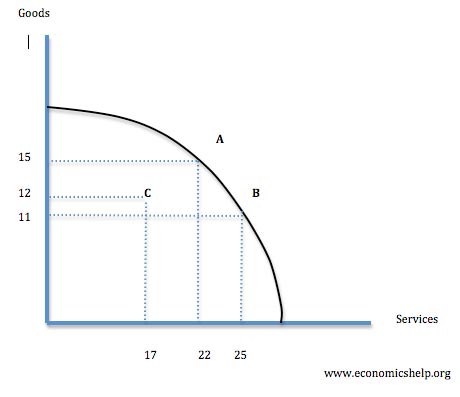
Definition: Productive efficiency can be defined as producing goods and services for the lowest cost. Productive efficiency is said to occur on the production possibility frontier. On the PPF curve, it is impossible to produce more of one good without producing less of another.
In the diagram below. If you are at point A you can’t produce more services without foregoing goods.
ppf
Point C in graph is productively inefficient because you can produce more goods or services without an opportunity cost.
Lowest Point on SRAC Curve
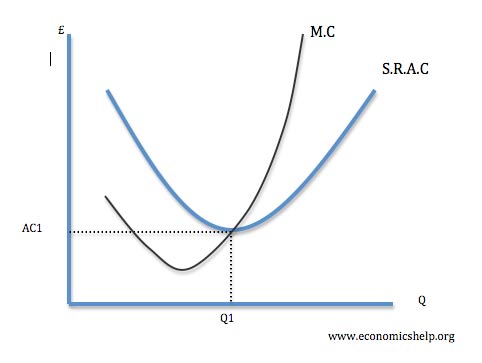
Productive efficiency also involves producing at the lowest point of the short run average cost curve (where MC cuts the bottom of the SRAC curve.)
ac
Usually, productive efficiency refers to the short run (i.e. producing at lowest point of SRAC curve) But if can also refer to producing at the lowest point on the Long Run Average Cost curve LRAC i.e. benefiting from economies of scale
Related to productive efficiency is the concept of Technical efficiency. Technical efficiency specifically refers to to the optimal combination of inputs, i.e. using minimum combination of labour and capital to produce a certain quantity of goods.

Allocative Efficiency

Allocative efficiency is quite different this is more concerned with the distribution and allocation of resources in society.

For example, there is no point in being productively efficient if all resources are diverted to making guns. We could be producing on a production possibility frontier but, if it is all guns, society may not have enough food and health care. An anecdote from the Soviet Union under Communist days tells how factories were given targets to produce certain quantities of goods. They often did this with great vigour and were productively efficient, but, often they were producing goods which weren’t needed by society. There is a story that one factory made left hand boots that nobody wanted, so at the end of the day they would efficiently burn them and the next day start again! But, people didn’t mind too much as they had a job.
Allocative efficiency looks at the marginal benefit of consumption compared to marginal cost. Allocative efficiency will occur when marginal benefit = marginal cost.

We can assume price = marginal benefit. So we also say
  • Allocative efficiency occurs where price = Marginal cost.
  • Monopolies are often said to be allocatively inefficient because they are able to set the price higher than marginal cost. See: Monopoly
Related to allocative efficiency is the concept of social efficiency. Social efficiency makes a point of taking into account all externalities so we can try and equate social marginal benefit and social marginal cost.

Productive efficiency (again)

It is important that a business makes effective use of its assets. The investment in production capacity is often significant. Think about how much it costs to set up a factory; the production line with all its machinery and technology. One way to look at how efficiently a business operates is to look at "productivity".
 
Productivity measures the relationship between inputs into the production process and the resultant outputs. Productivity can be measured in several ways: e.g.
  • Output per worker or hour of labour
  • Output per hour / day / week
  • Output per machine
  • Unit costs (total costs divided by total output)
The unit cost measure is particularly important. A falling ratio would indicate that efficiency was improving.

Why is achieving high productivity important?
  • Most importantly, a more efficient business will produce lower cost goods than competitors. That means the business can either make a higher profit per unit sold (assuming that the product is sold for the same price as a competitor) or the business can offer customers a lower price than competitors (and still make a good profit/
  • Investing in production assets (e.g. equipment, factory buildings) is expensive – a business needs to maximise the return it makes on these assets
There are various ways in which a business can try to improve its productivity:
  • Training – e.g. on-the-job training that allows an employee to improve skills required to work more productively
  • Improved motivation – more motivated employees tend to produce greater output for the same effort than de-motivated ones
  • More or better capital equipment (this links with the topic of automation)
  • Better quality raw materials (reduces amount of time wasted on rejected products)
  • Improved organisation of production – e.g. less wastage